- Saturday
Unlocking Comprehension: Explicit Vocabulary and Background Knowledge for Dual-Identified Middle Schoolers
- Canissa Grant
- Dual Language Instruction, Reading Literature
- 0 comments
Imagine packing your bags for a trip without knowing your destination, your itinerary, or even the language spoken when you arrive. That same sense of disorientation is exactly what our dual-identified students experience when they are handed a complex middle school text without first building the context.
Too often, the standard directive in an English Language Arts (ELA) classroom is simply, "Turn to page 345 and begin reading independently." Our emergent bilinguals and students receiving special education services might dutifully open their books, but navigating dense academic language and unfamiliar cultural landscapes without a map is a setup for frustration, not comprehension. To truly support these learners, we must move away from the expectation that they will simply "pick it up" as they read. Establishing intentional pre-reading routines—specifically, explicit vocabulary instruction and background knowledge building—is the critical bridge to unlocking that text. In this post, we will dive into the research behind designing accessible, effective pre-reading strategies that empower dual-identified students to actively participate and thrive in dual language ELA classrooms.
The Intersectionality of Dually Identified Adolescents
When we look closely at our middle school classrooms, we see that language acquisition and learning disabilities cannot be treated as separate islands. Dually identified students require cohesive programming that addresses their language development alongside their disability accommodations (Castellón et al., 2023). Too often, these learners experience segregated services that view their needs through a deficit lens. Instead, we must embrace neurodiversity affirming practices. By utilizing Universal Design for Learning, educators can create environments where structured language support and specialized accommodations work seamlessly together. This unified approach prevents the fragmentation of their education and positively impacts their long term academic trajectories.
Effective adolescent literacy instruction for multilingual learners must balance two essential elements. Researchers emphasize bridging the science of reading with the love of reading (Farran & Griffin, 2022). The science provides the targeted, evidence based explicit instruction our students need to decode and comprehend. The love brings in engaging, culturally sustaining learning experiences that validate their identities. When we merge evidence based academic interventions with an authentic appreciation for who our students are, we build a foundation of trust and rigor.
While dual language programs offer incredible cognitive and cultural benefits, simply placing dually identified students in an immersive environment is not enough. Complex academic language is rarely acquired by osmosis alone. Students do not magically absorb advanced vocabulary or intricate background knowledge just by being surrounded by it. They need structured, intentional scaffolding to access rigorous grade level content. By proactively dismantling the barriers to comprehension, we empower them to not only read the text but to critically engage with it.
Essential Pre Reading Strategies for Dually Identified Learners
Reading comprehension is an active interaction between the text on the page and the internal schema of the reader. If a dually identified student lacks the specific cultural or academic background knowledge assumed by a text, decoding skills alone will not bridge the comprehension gap. Establishing robust pre reading routines in the dual language ELA classroom is not just a helpful accommodation; it is a necessary foundation. By intentionally building a shared context before diving into a complex text, educators provide the cognitive scaffolding needed to reduce working memory load and promote deep engagement.
A cornerstone of this pre reading routine is explicit vocabulary instruction. Vocabulary serves as the linchpin of reading comprehension. Multilingual learners and students receiving special education services show the most significant improvements in reading competence when teachers explicitly teach targeted academic words. Rather than hoping students infer meaning from context, educators should select a handful of high leverage academic words to introduce upfront. Anchoring this instruction in structured literacy practices, such as explicitly teaching morphology, is highly effective. Breaking down words into Latinate roots, prefixes, and cognates helps students bridge the linguistic structures of both program languages and builds a flexible vocabulary toolkit.
Beyond vocabulary, educators must systematically activate and build background knowledge. Teachers can rapidly construct a shared context using brief, high quality visual inputs like a short video, a piece of realia, or a compelling photograph before introducing the written text. Furthermore, explicitly drawing connections between the themes of the text and the lived experiences of the students activates their rich funds of knowledge. Validating their cultural identities creates a meaningful bridge to unfamiliar academic concepts. This approach not only supports comprehension but directly fulfills the dual language pillar of cross cultural competence, ensuring that all learners feel seen, valued, and prepared to tackle rigorous middle school literacy tasks.
Conclusion and Call to Action
Supporting dually identified adolescents in middle school ELA requires much more than simply providing access to a dual language environment. It demands a unified, neurodiversity affirming approach where explicit vocabulary instruction and the intentional building of background knowledge form the foundation of every literacy lesson. By merging evidence based structured literacy practices with culturally sustaining instruction, we can transform dense academic texts from insurmountable hurdles into accessible opportunities for profound cognitive growth.
To truly shift the landscape for our complex learners, systemic change and individual commitment must go hand in hand.
For District Leaders: We must dismantle the silos that separate special education, English language development, and general education. Your call to action is to provide the structural support necessary for this integration. Educators require dedicated, collaborative planning time and targeted professional development to design inclusive curricula rooted in Universal Design for Learning. When leaders prioritize cohesive programming over isolated interventions, entire school systems become equipped to support the holistic needs of dually identified students.
For General Education Teachers: You hold the power to change the daily narrative for these students. Challenge yourself to move beyond the traditional directive of independent reading without a map. View yourself as an architect of accessibility. Commit to implementing one intentional pre reading routine in your upcoming lesson plans. Whether you choose to utilize multimedia to build shared schema or explicitly map the morphology of a core academic term, your proactive scaffolding is the key to unlocking grade level comprehension.
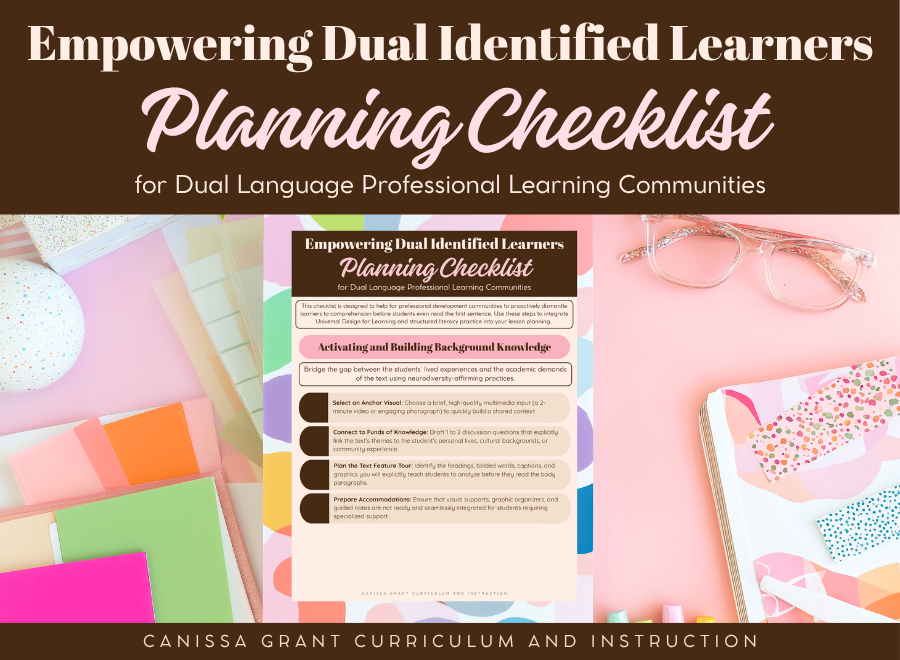
To support your instructional planning and help you implement these routines seamlessly, I have created an exclusive resource for our community. I created the Planning Checklist for Pre-Reading for PLCs to allow ELA teachers in dual language programs to support the needs of dual-identified students in dual language programs.
https://www.canissagrant.com/planning-checklists-for-pre-reading-strategies-for-plcs
References
Castellón, F. A., Sturm, A., & Kasari, C. (2023). Dual identification: Trajectories to English proficiency for English learners with autism spectrum disorder. Journal of Autism and Developmental Disorders, 54, 2615–2624. https://doi.org/10.1007/s10803-023-05994-9
Farran, L. K., & Griffin, R. A. (2022). The love and science of reading: A promising instructional approach for adolescent multilingual learners. Perspectives of the ASHA Special Interest Groups, 7, 197–208. https://doi.org/10.1044/2021_persp-21-00192
Gallagher, M. A., Beck, J. S., Ramirez, E. M., Barber, A. T., & Buehl, M. M. (2023). Supporting multilingual learners’ reading competence: A multiple case study of teachers’ instruction and student learning and motivation. Frontiers in Education, 8. https://doi.org/10.3389/feduc.2023.1085909